

My whole personality as of late has been my story on artist Sam Shoemaker and his mushroom kayak for The Guardian. As it should be…it has brought a lot of joy to people! I’ll plug him one last time: check out Sam’s exhibition at Fulcrum Arts in Pasadena from October 10-January 31, which will feature large-scale projections, time-lapse videos, and soundscapes from his fungal-fueled journey.
On that hope tip…I felt all the more hopeful after seeing Dana Davenport’s solo exhibition, ‘one hundred days,’ at Tiger Strikes Asteroid LA, available to view through October 12. Dana is a Korean and Black American interdisciplinary artist whose sculptural, video, and performance works have been featured in Seventh Gallery (Melbourne) Gibney (New York), and Watermill Center (New York). She is interested in imagining the collective futurity of Black and Asian peoples with a deep respect for the history of diasporic and global movements that have engendered inter-minority conflicts in America.
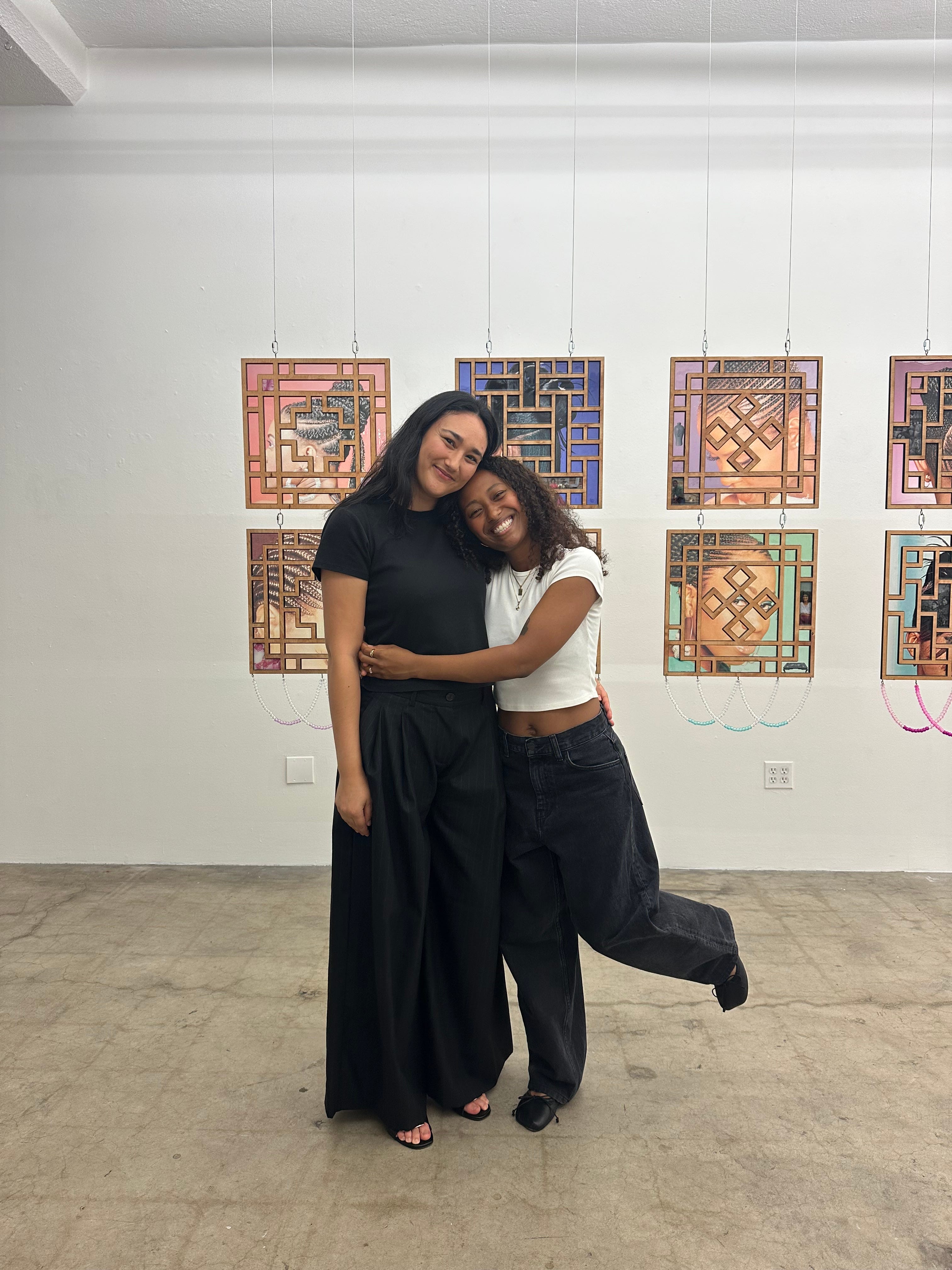
Dana transforms everyday household objects––chandeliers, windows, family photos––into sculptural works that reflect on themes of kinship. Together, her works for ‘one hundred days’ explores the significance of domestic spaces and the narratives that go into making a home. The title is a reference to the Korean tradition of celebrating a baby’s first 100 days of life, which was considered a milestone for families when the country endured high infant mortality rates. Today, a baek-il party is an occasion to welcome one’s child to family members and friends and celebrate good health with booze, gifts, and so so many seasonal fruits and ricey red bean cakes. ‘one hundred days,’ as a title, is also special to Dana right now as she basks in the joy of being a mother to a one-year-old girl.
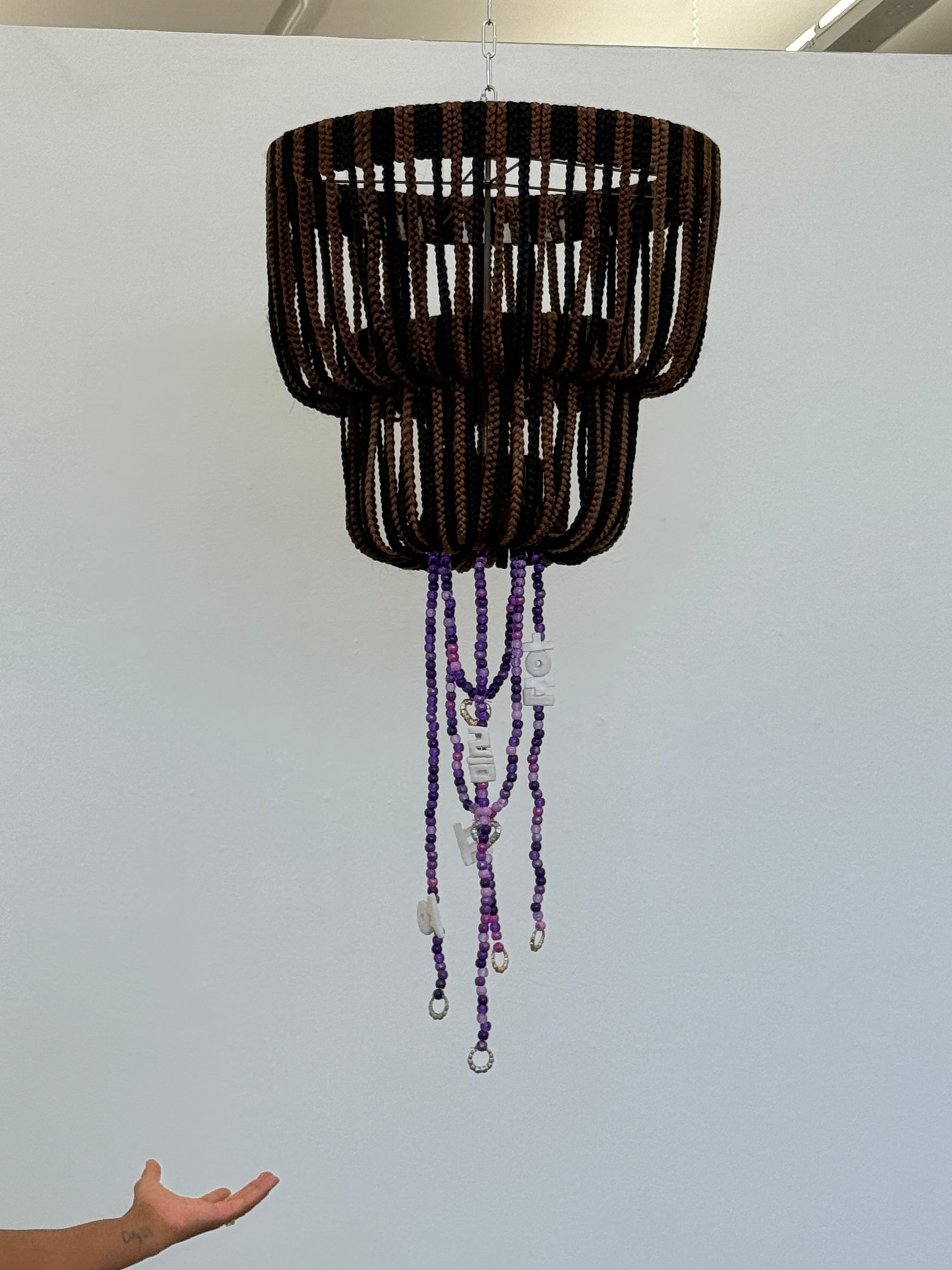
In recent years, Dana has received attention for her Box Braid Chandeliers series, several of which are on display as a part of her exhibition. Made with plastic hair beads, accessories, and synthetic hair braids from local beauty supply stores, the sculptures are as lighthearted as they are moving. On newer chandeliers dangle cowry shells and Korean phrases that translate to “Miracle on the Han River” and “Hot Girl Summer.” Because of their very nature as hanging centerpieces, they invite us to look up at each of them in search of optical illusions and breaks in light and space. Our mind is trained to look for refractions bouncing off each “prism” of the chandelier; instead we see Dana’s reflections on the labor that goes into making hair braids, and her own experience as a Black woman growing up unseen yet hyper-visible in Korea. Here, the chandeliers serve as a proxy for her own body as she navigates her two cultural identities.
After being born in Virginia, Dana spent her early and adolescent years attending school on a military base in South Korea, where her parents met while her dad was in service. After Dana and her sister graduated high school and left for college, their parents stayed behind in Korea. For her dad, military service eventually provided upward mobility into working class privileges. This was not an uncommon decision among Black Americans who sought stability in an era of de jure desegregation in schools, workforces, and the Army. Knowing how Dana’s parents met, I personally wonder about the Black experience of going into Korea shortly after it was cleaved into two by Western muscle, and then being tasked to maintain that imperialist presence. During a walkthrough of the exhibition, Dana mentioned that she does not know how her dad feels these days about his time in Korea.
Through her chandeliers, Dana finds an entry point to engage viewers on the history of Korean Americans in the beauty supply business. After the country was divided in 1953, South Korea found immense value in women’s hair as a commodity and used it to supply the global wig industry. By the 1970’s, wigs became a top export out of South Korea, raking in over $93 million in annual revenue. Contemporaneously, the Hart-Cellar Act spurred a massive increase in Korean immigration to the United States. With a strong Korean supply chain of wigs and network of exporters, many Korean families found stability by establishing beauty supply stores in metropolitan areas like New York, Los Angeles, and San Francisco.

Many of us know what happened in L.A. in the decades that followed, but Dana’s show is not particularly interested in re-examining what we already know about the inherent racism and scarcity mindset that fomented the unbalanced relationship between Korean American beauty store owners and Black patrons. ‘one hundred days’ is instead earnest in its presentation of lesser known histories that yielded such inter-minority tension. While doing research for her Window series, Dana came across archival images of sweets-sellers in the ‘50s and ‘60s who wheeled their carts into different towns and gave Korean children yeot candy in exchange for their thick, long tresses. She asked her mom about these photos and asked if she recalls similar exchanges, later learning that mothers of lower-income households would even cut their children’s hair to purchase rice, noodles, and other key ingredients to feed their families.
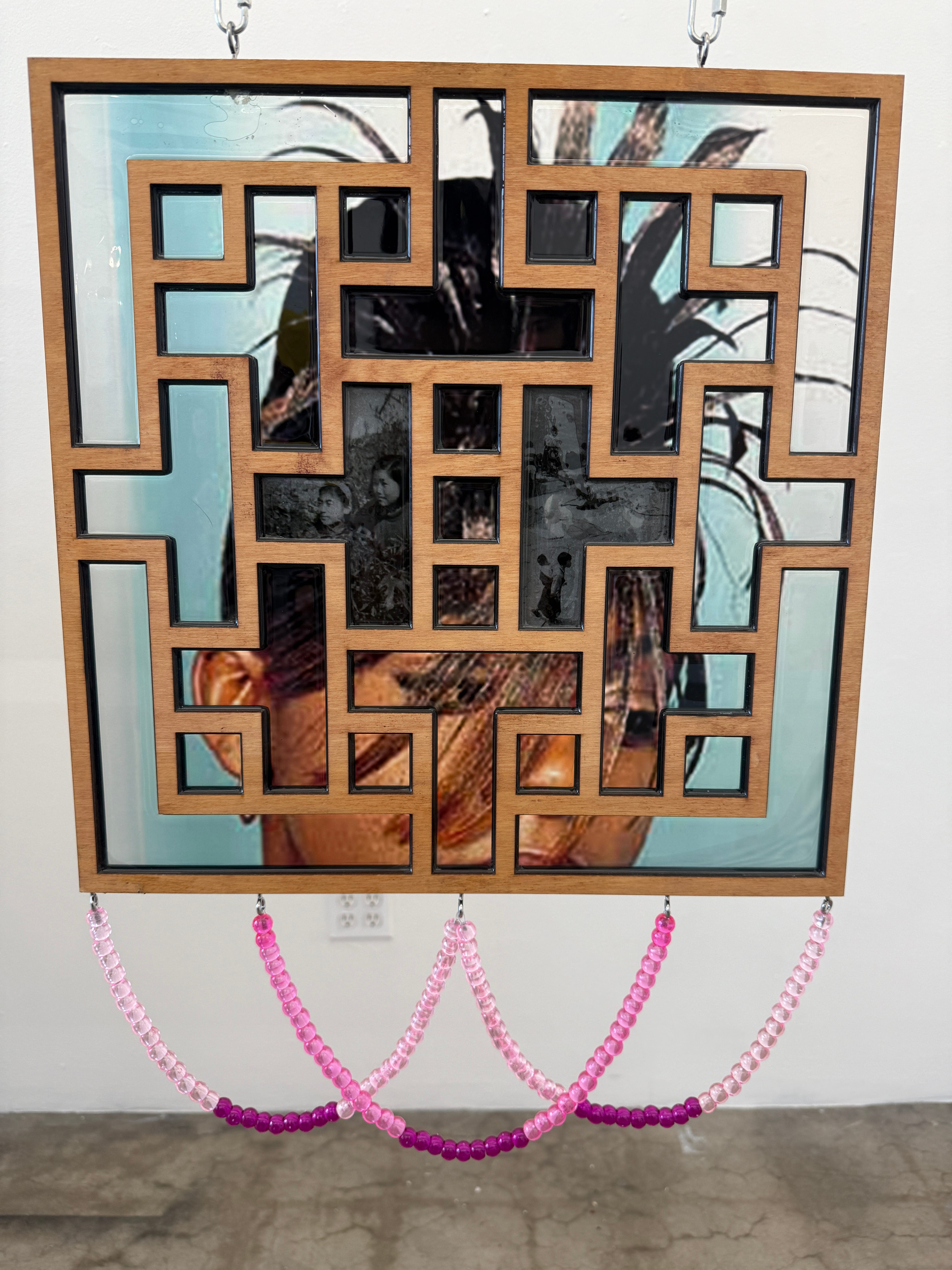
I love Dana’s search for context, despite the existential challenges that arise from embracing two seemingly different cultural identities. Through both her Box Braid Chandeliers and Window series, I lament the postmodern South Korean patriarchy that has subjected Korean women to such labor as cutting their own hairs in order to supply the needs of other women throughout Europe and North America. When the wig industry boomed by the ‘70s, Korean women found themselves in even more exploitative situations, where they would be trained only on singular or menial steps in the production process to reduce mobility into management roles, let alone access to higher wages. As South Korea redefined its nationalism through rapid economic development, women laborers gradually banded for more autonomy in the way they work. In 1979, the women-led YH labor union occupied the wig exporter YH Trade and eventually the headquarters of the National Democratic Party to protest sudden layoffs and demeaning working conditions. About 2,000 riot police evicted all women laborers from the headquarters; one woman was killed, union leaders were arrested, and the rest of the protesters were forced back home. No concessions were provided, but to date, later generations that have come out of the YH labor union (Korean Women Workers Association, Korean Women’s Trade Union) continue to fight for fair wages and working conditions.
We will always be in agony so long as we surrender to a system that subscribes to patriarchal nationalism and centers white supremacy. But once we understand deeply how both of these oppressive ideologies have informed our individual survival (why we go into the Army, where we immigrate, who our businesses serve), we start to become more relational. In fact, I have an inkling that we are often scared of abolition because we do not contextualize our own histories of struggle with each other more often, let alone transnationally.
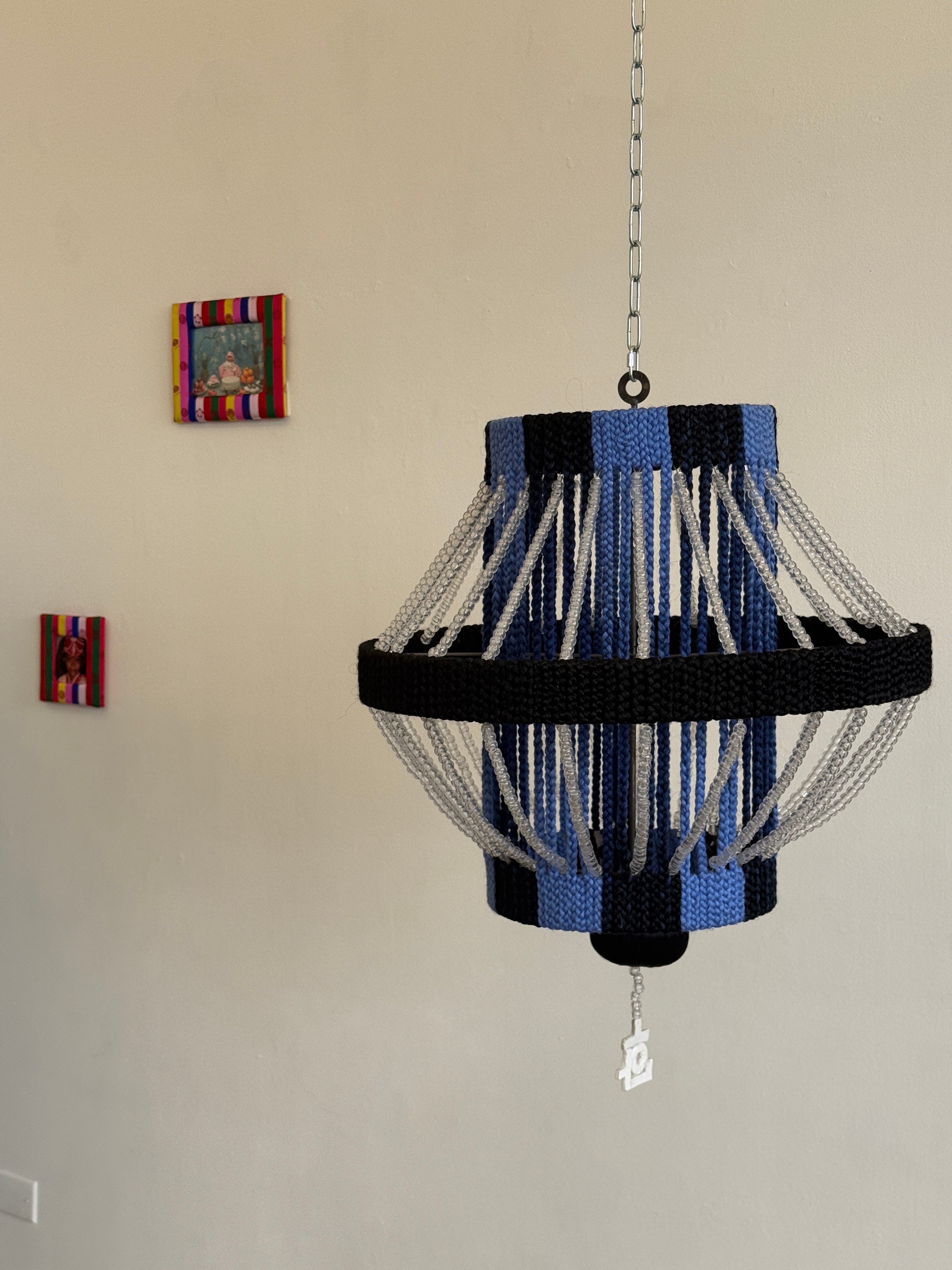
I will think long about one of Dana’s most recently created chandeliers. It alternates between denim blue and black in color, and its structure is a little more complex compared to her earlier creations. Clear plastic beads act as decorative buttresses, branching out to create a lantern shape that invites you to look through the spaces in between the braids and beads. From the bottom of the chandelier dangles one Korean word, han, which loosely translates to the Korean people’s collective grief and resentment from centuries of oppression.
“I wish that sentiment of han expanded beyond who is considered Korean,” says Dana. “If only that concept of collective suffering could also be extended to me and my experience in Korea as a Black person.”
In recent years, han has invoked prickly reactions among gyopos (people of the Korean diaspora) who want to move away from identity politics and reclaim themselves through the lens of joy and creation. That’s all good and fine, but how curious it is to see that a Black American woman, with her own individual experience in Korea, also makes meaning of han. What a relief it is to see that another identity understands the internalized feeling of sorrow, regret, and shame that psychically alters how we communicate and take care of each other! Our Korean suffering is not unique; it simply feels isolating because that’s colonialism by design.
I walked out of Tiger Strikes Asteroid remembering that all of Dana’s archival research on her family and Korean history ultimately informs how she wants to raise her baby girl. Her resulting exhibition shows the great stability and hope she feels in being a mother, one who sees any perceived complexities of her identity as catalysts for dialogue.
“Between [my partner] Marcel and me, Black culture is something that we share, but [my daughter’s] connection to Korea will be through me, just as my connection to Korea is through my mom,” says Dana. “There’s a desire to heal that aspect. I felt angry [about it] for a long time, but it feels even more pressing to continue to heal […] resolve some of those things within myself.”
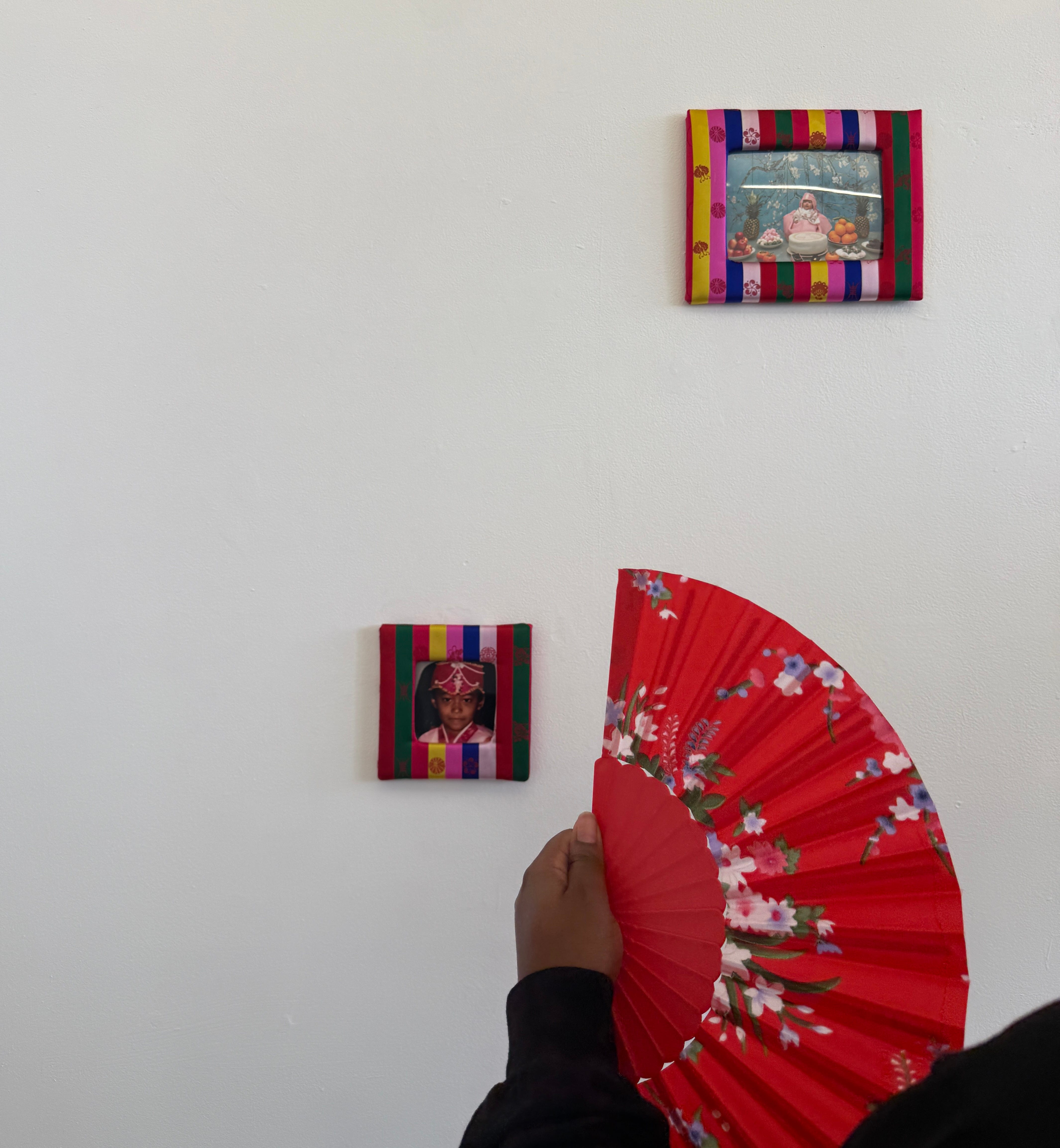
‘one hundred days’ is available to view through October 12, 2025 at Tiger Strikes Asteroid LA.
yessss i learned about the strike history recently in Shin Kyung Sook's novel The Girl Who Wrote Loneliness!! sad to miss the exhibit but i'm glad i got to read the backstory!